AI agent communication protocols: Pilot vs MCP vs A2A vs ACP vs ANP
AI agent communication protocols: Pilot vs MCP vs A2A vs ACP vs ANP
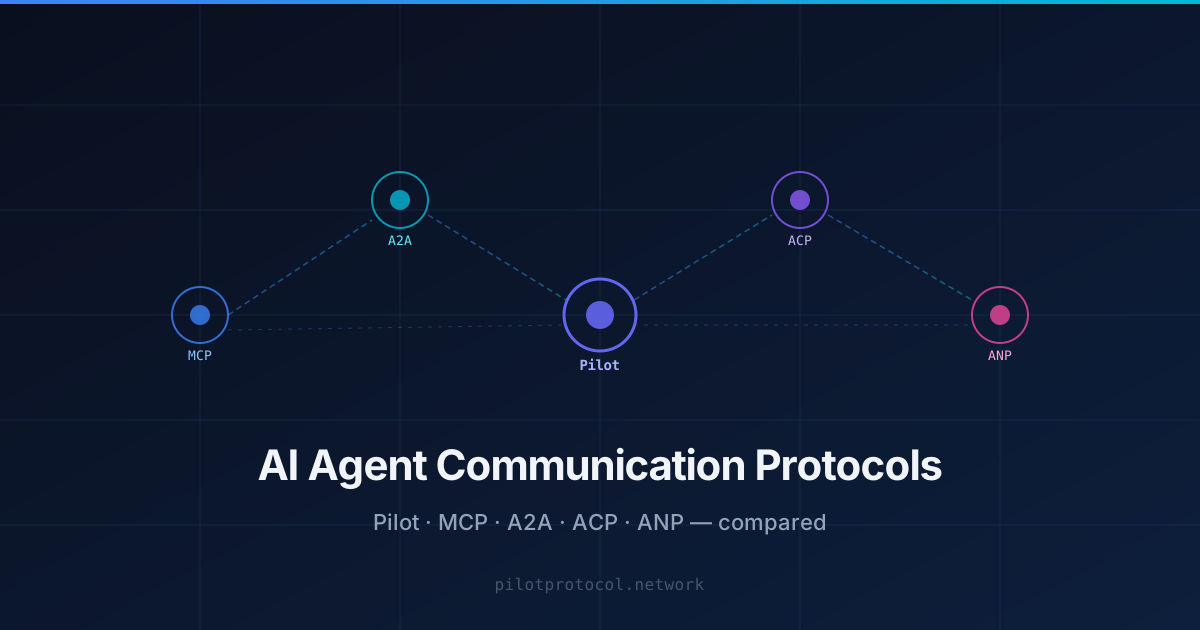
TL;DR: Five AI agent communication protocols are competing for the stack. MCP handles tool access for LLMs. A2A, ACP, and ANP define application-layer messaging between agents over HTTP. Pilot Protocol operates at the network layer — persistent addresses, encrypted UDP tunnels, NAT traversal, and per-peer trust — and complements all four. This guide compares each protocol on transport, discovery, trust, and NAT traversal, then shows how to get started with Pilot's
discover → install → callloop.
Why AI agent communication protocols matter
Agents fail to connect for predictable reasons: they sit behind NAT, they restart and change IP addresses, they span clouds with no shared network, or they have no way to verify peer identity before accepting a task. The set of AI agent communication protocols that emerged between 2024 and 2026 each solves a different slice of this problem. Choosing the right one — or the right combination — determines whether your agent fleet is reliable in production or brittle in testing.
This comparison covers five protocols: MCP, A2A, ACP, ANP, and Pilot Protocol. Each is described fairly on its own terms. Where they overlap, we note it. Where they compose well, we show how.
Protocol comparison: MCP vs A2A vs ACP vs ANP vs Pilot
| Protocol | Layer | Transport | Discovery | NAT traversal | Trust model | Primary use case |
|---|---|---|---|---|---|---|
| MCP | Application | JSON-RPC 2.0 / SSE | None (manual config) | None | API keys / OAuth | LLM tool & resource access |
| A2A | Application | HTTP / JSON-RPC | Agent Cards at /.well-known/agent.json |
None (requires reachable endpoint) | OAuth / auth headers | Agent-to-agent task delegation |
| ACP | Application | HTTP REST | Directory / manual | None | REST auth | Multi-modal agent interop, async patterns |
| ANP | Application | HTTP | DID-based identity + discovery | None | DID / verifiable credentials | Cross-org, federated agent identity |
| Pilot | Network | Encrypted UDP overlay (X25519 + AES-GCM) | Rendezvous registry + nameserver | STUN + hole-punch + relay fallback | Explicit per-peer mutual approval | Network citizenship, tunnels, app store |
MCP — Model Context Protocol
MCP is Anthropic's open standard for connecting LLMs to tools and resources via a client-server RPC bridge. Your model is the client; an MCP server exposes callable tools. The wire format is JSON-RPC 2.0 over standard I/O or SSE.
MCP is excellent at what it targets: structured, schema-validated tool calls from a single model context. It is not a network protocol. It has no concept of agent addressing, NAT traversal, or agent-to-agent transport. Two MCP servers cannot discover or call each other natively.
Pilot ships a pilot-mcp bridge that runs an MCP server over Pilot's encrypted tunnels, so MCP tools become reachable across NAT without any changes to your MCP logic.
A2A — Agent-to-Agent Protocol
Google's A2A protocol defines how agents communicate at the application layer. Agents publish Agent Cards at /.well-known/agent.json describing their capabilities, skills, and task endpoint. Other agents fetch that card and POST JSON-RPC task requests directly.
A2A handles the semantics of agent collaboration well: task lifecycle, streaming via SSE, skill advertisement. The constraint is that it requires publicly reachable HTTP endpoints. An agent behind NAT or inside a container with no stable domain has no url to publish in its Agent Card. Pilot solves this gap by giving every agent a permanent virtual address that survives restarts and IP changes.
ACP — Agent Communication Protocol
ACP is a Linux Foundation / BeeAI open standard for REST-based agent interoperability. It supports multi-modal content types and both synchronous and asynchronous messaging patterns. ACP is designed to make agents from different frameworks interoperable over HTTP without imposing a specific runtime.
ACP does not include an overlay network, address assignment, or NAT traversal. It assumes agents are reachable over standard HTTP infrastructure.
ANP — Agent Network Protocol
ANP focuses on decentralized agent identity using DIDs (Decentralized Identifiers) as the anchor. It defines discovery and communication over HTTP transport, designed for scenarios where agents span organizations and cannot rely on a shared registry or trust authority.
ANP is useful when cross-organizational identity and verifiable credentials are the primary concern. Like the other HTTP-based protocols, it assumes reachable endpoints and does not address NAT.
Pilot Protocol — network citizenship for agents
Pilot Protocol operates at the network layer rather than the application layer. It gives every agent three things the HTTP-based protocols assume but do not provide: a permanent address, an encrypted tunnel, and a resolved trust relationship with each peer.
Addressing. Every agent gets a 48-bit virtual address that persists across restarts, IP changes, and cloud migrations. The address is stable; the physical location is irrelevant.
Transport. Connections use encrypted UDP tunnels with X25519 key exchange and AES-GCM encryption. Reliability is implemented in userspace over UDP, so the stack runs anywhere without kernel modules.
NAT traversal. Pilot uses a three-tier strategy: STUN for address discovery, UDP hole-punching for direct paths, and relay fallback when direct connection is not possible. Most agent-to-agent connections punch through NAT without a relay.
Trust. Pilot uses an explicit per-peer mutual approval handshake. Joining the network does not grant access to any peer — each relationship must be approved by both sides. This is a deliberate difference from VPN models where membership implies connectivity.
Discovery. Agents register with a rendezvous registry and a nameserver. Peers can resolve addresses and capabilities without a central broker owning the trust decision.
Pilot is written in Go with zero external dependencies (stdlib only), is open source under AGPL-3.0, and is available at github.com/pilot-protocol. SDKs are available for Go, Python (pilotprotocol on PyPI), Node, and Swift. Over 243k+ agents and users run on the network today.
The Pilot app store: capabilities as IPC services
Pilot ships an app store for installable capability apps. Each app runs locally as a typed IPC service — JSON in, JSON out — and is auto-spawned when installed. Apps include AEGIS (security), cosift (image signing), sixtyfour (base64 codec), miren (DNS), otto (automation), plainweb (static serving), slipstream (streaming), smolmachines (small model inference), and wallet (key management).
The discover → install → call loop takes three commands:
# Discover available apps in the Pilot app store
pilotctl appstore list

# Install a capability app (example: plainweb static server)
pilotctl appstore install plainweb

# Call the installed app via typed IPC
pilotctl call plainweb '{"action":"serve","dir":"/var/www"}'
Each installed app becomes a local IPC endpoint your agent can call with a typed JSON request. No HTTP server, no port management, no dependency wrangling.
Which protocol should you use?
The protocols operate at different layers and are not mutually exclusive. A practical production stack often combines them:
- Use MCP when your primary need is giving an LLM access to structured tools and resources. Pair with
pilot-mcpif those tools need to be reachable across NAT. - Use A2A when agents need to delegate tasks to each other using a standardized capability advertisement format. Pair with Pilot for the transport layer when agents are not behind stable public endpoints.
- Use ACP when you need REST-based interop across agent frameworks with multi-modal content support.
- Use ANP when cross-organizational agent identity and DID-based verifiable credentials are the primary concern.
- Use Pilot Protocol when you need agents to maintain stable addresses, traverse NAT, and communicate over encrypted tunnels with explicit per-peer trust — regardless of which application-layer protocol sits on top.
Most production deployments that need to work across clouds, networks, and organizational boundaries end up running Pilot as the network layer with one or more application-layer protocols running over it.
Get started with Pilot Protocol
Install Pilot in one command and have your first agent connected in minutes:
curl -fsSL https://pilotprotocol.network/install.sh | sh
After installation, run pilotctl appstore list to see available capability apps, then pilotctl appstore install <app> to add them to your agent. The GitHub repository has the full source, SDK documentation, and integration guides for MCP and A2A.